

Care Team
We do not approach our Palliative Care services as “one size fits all.” The SASC Care Team will provide as much support as you need and specialize the level of clinical care that is appropriate for you. Whatever stress you may be experiencing physically or emotionally, your Care Team is here to address it and improve quality of life for both you and your family. SASC will provide 24-hour support, 7 days a week; even on weekends and holidays to service our patients and their families.
Roles of Care Team
Help you better understand your disease and diagnosis
Help clarify your treatment goals and options
Manage your symptoms and physical pain
Understand and support your ability to cope with your illness
Provide emotional & spiritual support or resources
Assist you with advanced care planning
Coordinate with your other doctors
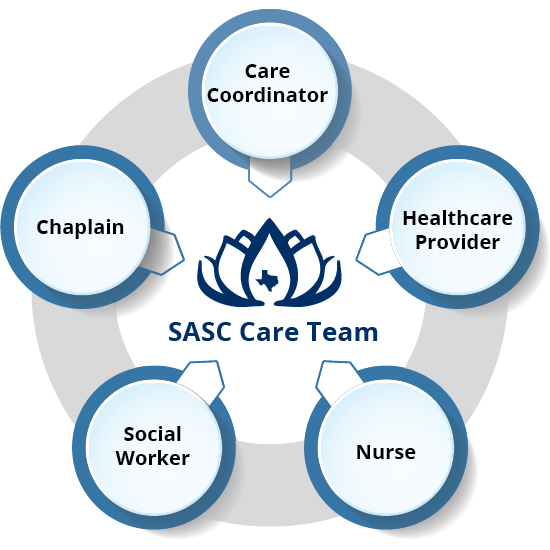
CARE COORDINATOR: Coordinators will conduct evaluations to begin the process of Palliative Care and align the initial resources to match the patient and family’s needs. They will answer all of your questions and discuss how to begin the Path to Palliative Care. They will also gather preferences on how you and your family would like to receive spiritual or emotional support if necessary.
HEALTHCARE PROVIDER: Our provider (doctor/nurse practitioner) partners with your own primary care doctor and specialist(s) to customize a treatment plan that is best suited for you.
NURSE: Nurses are trained to recognize your pain and symptoms. The nurse will act as the liaison between patient, the healthcare provider, and other members of your Care Team. They will assist you and your family, or primary caregiver, with education needed to help understand your illness and manage your care. Over time, they will continually evaluate your needs and resources.
SOCIAL WORKER: The social worker is a limited resource and may assist with navigating insurance benefits and financial responsibilities needed to provide care for the patient. The social worker can connect you with community organizations or volunteers which may be beneficial to overcome the day-to-day challenges that come with an illness or disease.
CHAPLAIN: A non-denominational Chaplain is available to you and your family as a limited supportive resource when needed to assist with any spiritual or emotional health. Trained as expert listeners and emotional/spiritual counsels, they work with everyone who needs support, regardless of faith and beliefs. They will communicate empathetically with you and your family during times of emotional fatigue. If patient & family prefer resources that align with any of their own religious or cultural affiliations, a requested Pastor, Priest, Pandit, Imam, etc. can be coordinated based on personal choice.
Questions to ask your Care Team
We know how overwhelming it can be to decide on the best Palliative Care provider and how important it is for you to trust us with your care. Ask us a few of these questions to help you pick the best service for you!
What can I expect from palliative care?
Where will my care be provided (e.g., in the hospital, home, nursing home)?
Who is on the palliative care team?
What are your recommendations for my care?
What decisions need to be made by either my family or me?
Will you help explain my treatment choices and the issues involved in making these decisions?
Will you communicate openly and candidly with my family and me about my illness?
Will you continue to be involved in my care when I am in the hospital (if you are an outpatient)?
Will you be involved in my care when I am discharged from the hospital or living at home?
How will you work with and communicate with all my other doctors?
What will you do if I experience severe pain or other symptoms?
What support will you provide to my family and/or caregivers?
Will you still be available to me throughout my illness?
How can I reach you?
What resources do you recommend for me to learn more about palliative care?
Care Coordinators will conduct evaluations to begin the process of Palliative Care and align the initial resources to match the patient and family’s needs. They will answer all of your questions and discuss how to begin the Path to Palliative Care. They will also gather preferences on how you and your family would like to receive spiritual or emotional support if necessary.
Our Healthcare Provider (doctor/nurse practitioner) partners with your own primary care doctor and specialist(s) to customize a treatment plan that is best suited for you.
Care Coordinators will conduct evaluations to begin the process of Palliative Care and align the initial resources to match the patient and family’s needs. They will answer all of your questions and discuss how to begin the Path to Palliative Care. They will also gather preferences on how you and your family would like to receive spiritual or emotional support if necessary.
Our healthcare provider (doctor/nurse practitioner) partners with your own primary care doctor and specialist(s) to customize a treatment plan that is best suited for you.